







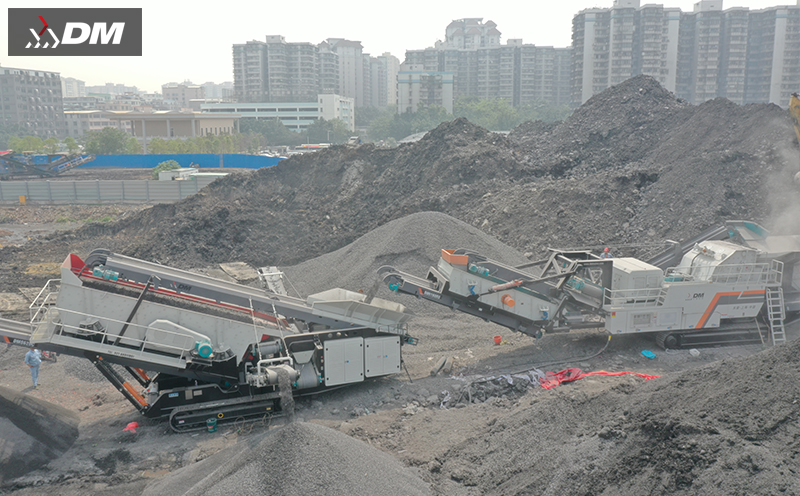
With the accelerated urbanization process in Papua New Guinea, the population of core cities such as Port Moresby, Lae, and Madang continues to gather, leading to an explosive annual growth in urban solid waste output. Data shows that Port Moresby alone generates over 3,000 tons of urban solid waste per day, including 38% construction waste (bricks, concrete blocks), 57% domestic waste (plastic, metal, kitchen waste, fabrics), and the remaining 5% commercial and industrial waste. The traditional disposal method is dominated by open-pit landfilling, which not only occupies over 400 mu of valuable land resources each year but also causes leachate to pollute soil and groundwater due to the lack of anti-seepage treatment, threatening the health of residents living near coastal areas and rivers; at the same time, infrastructure projects such as road expansion, affordable housing construction, and port upgrades in Papua New Guinea are advancing intensively, with an annual demand gap of over 30% of the total demand for construction aggregates. Natural sand and gravel resources are increasingly exhausted, and some regions need to import from neighboring countries, significantly driving up project construction costs.
The dual dilemma of "waste siege" and "resource shortage" has become a core bottleneck restricting the sustainable urban development and infrastructure acceleration in Papua New Guinea. The urban solid waste resource recycling solution takes "intelligent sorting + graded crushing + resource regeneration + environmental closed-loop" as the full-process core, completely breaking the limitations of traditional landfilling models, transforming urban waste from an "environmental burden" into "circular wealth", achieving a resource utilization rate of over 85% for urban solid waste, and providing a one-stop solution that balances ecological and economic benefits for the local area.
I. Core Structure: A Full-Process "Waste-to-Resource" Conversion System
The urban solid waste resource recycling solution is not a single piece of equipment, but an integrated full-chain system integrating "pretreatment - intelligent sorting - graded crushing - shaping - multi-stage screening - resource regeneration - environmental treatment". Through precise division of labor and efficient collaboration, its core links progress step by step and interlock to maximize the value of resource recovery:
1. Pretreatment + Intelligent Sorting: Precisely Separating Various Usable Resources
Targeting the characteristics of "complex composition and high impurity content" of urban solid waste in Papua New Guinea, the front end of the solution is equipped with a multi-dimensional pretreatment and intelligent sorting system to ensure efficient separation of recyclable resources and crushable materials:
- Pretreatment link: Combines a heavy-duty drum screen with manual sorting pretreatment stations to first separate large debris (such as waste furniture, large building materials) above 500mm in diameter from fine materials of 0-50mm, with a screening efficiency of 80 tons per hour, avoiding blockage of subsequent crushing equipment by large impurities, and the pretreatment qualification rate exceeds 95%;
- Intelligent sorting module: Integrates metal sensors, near-infrared optical recognition systems, and strong magnetic suction devices to automatically identify and separate metals (iron, aluminum, etc.) with a recovery rate of 98%, PE/PP plastics with a recognition accuracy of 96%, wood and other recyclable resources from solid waste, with a sorting speed of 1,200 pieces per hour, which is 300% higher than the efficiency of traditional manual sorting;
- Manual auxiliary optimization: Sets 3-5 manual sorting stations for secondary sorting of special materials not identified by the intelligent system (such as glass fragments, steel bars in construction waste, tangled fabrics), increasing the sorting purity to 99% and laying the foundation for subsequent resource regeneration.
2. Graded Crushing + Shaping & Screening: Producing High-Standard Recycled Resources
For sorted construction waste (bricks, concrete blocks) and inert materials, the solution adopts a refined treatment process of "primary crushing - secondary crushing - tertiary crushing - shaping - multi-stage screening" to produce recycled resources that meet Papua New Guinea's construction industry standards (AS/NZS 4455):
- Graded crushing process: The primary crushing module uses a jaw crusher to process large materials (≤500mm) with a crushing pass rate of 98%; the secondary crushing module crushes materials to ≤50mm through a cone crusher, with a crushing efficiency 25% higher than that of traditional equipment; the tertiary crushing module is equipped with an impact crusher to achieve precise particle size control, avoiding material waste caused by over-crushing, and the raw material utilization rate reaches 95%;
- Aggregate shaping optimization: Impact crushing technology "shapes" recycled aggregates, reducing the proportion of needle-like particles (below 12%) and improving aggregate compressive strength (above 35MPa), making the compatibility between the performance of recycled aggregates and natural aggregates exceed 90%;
- Multi-stage screening and classification: Through a four-layer vibrating screen, the crushed materials are divided into four core products —— 16-31.5mm recycled coarse aggregates (for road bases, concrete structural aggregates), 8-16mm recycled medium aggregates (for concrete bedding, permeable brick production), 4.75-8mm recycled fine aggregates (for mortar mixing), and 0-4.75mm recycled manufactured sand (for wall plastering, tile adhesive), with a classification efficiency of 96% and a product qualification rate exceeding 98%.
These recycled resources can completely replace natural sand and gravel, directly supplying local infrastructure projects and building materials production enterprises, not only alleviating the pressure of natural resource shortage but also reducing raw material procurement costs (35%-40% lower than natural aggregates).
3. Environmental Closed-Loop Treatment: Meeting Papua New Guinea's Green Development Requirements
The solution follows the principle of "environmental protection first" throughout, and constructs a full-process environmental treatment system to control pollution from the source in response to Papua New Guinea's strict ecological protection policies (such as the Environment Act 2000 and the Waste Management Act 2015):
- Dust pollution control: The crushing, screening, and conveying links adopt fully enclosed corridors and sealed hoods, equipped with high-efficiency pulse bag filter systems, with a dust emission concentration of ≤10mg/m³, far below the local environmental protection standard limit (50mg/m³), and the dust emission reduction rate reaches 80%;
- Zero discharge of leachate: Sets up a leachate treatment system composed of a sump, sedimentation tank, filter tank, and disinfection tank to collect sewage generated during sorting and crushing. After treatment, it is recycled for equipment cooling, site cleaning, and aggregate humidification, realizing 100% recycling of water resources with no external discharge;
- Noise and waste control: Core equipment is equipped with sound insulation covers and shock absorption pads, reducing operating noise to below 75dB (10 meters away from the equipment), which is 40% lower than that of traditional equipment, meeting environmental protection requirements in residential areas; the proportion of non-recyclable inert waste (such as a small amount of sludge and uncrushable large debris) is only below 8%, which can be compressed and used as landfill cover soil or road subgrade filling, reducing landfill volume by 85% compared with traditional landfilling models.
4. Intelligent Control + Efficient Operation: Reducing Labor and Management Costs
The solution adopts automated and intelligent design, adapting to the current situation of high labor costs and shortage of professional and technical personnel in Papua New Guinea:
- Central intelligent control: Equipped with a PLC central control system, operators can real-time monitor the operation status of each link (capacity, equipment load, material flow) through a touch screen, and remotely adjust crushing parameters and screening specifications. Only 4-6 personnel are required to complete the full-process operation of a single production line (including inspection and maintenance), saving 60% of labor costs compared with traditional manual operation models;
- High processing capacity and stability: A single solution production line can handle 600-1,500 tons of urban solid waste per day, accounting for 20%-50% of Port Moresby's daily output. Large-scale projects can achieve a daily processing capacity of over 3,000 tons (covering the full daily solid waste output of Port Moresby) through multi-system parallel connection; core equipment is made of wear-resistant alloy materials, extending the service life of vulnerable parts by 35%, with annual shutdown maintenance time not exceeding 60 hours, and the Overall Equipment Efficiency (OEE) is stably maintained above 88%;
- Data-driven management: The system can automatically record daily processing volume, resource recovery rate, energy consumption data, etc., generate monthly/quarterly operation reports with a data accuracy rate of 99%, provide accurate decision-making basis for managers, and optimize operation efficiency by more than 15%.
II. Landing Value in Papua New Guinea: Dual Environmental and Economic Benefits
This urban solid waste resource recycling solution has been put into application at a solid waste treatment center in Lae, Papua New Guinea, and has achieved remarkable benefits within six months of operation, becoming a local "circular economy" demonstration project:
- Resource regeneration benefits: Processes 800 tons of solid waste per day, accounting for 40% of Lae's daily solid waste output. Among them, 320 tons of construction waste are converted into recycled aggregates and manufactured sand (with a conversion rate of 40%), supplying Lae Port expansion project and suburban road project monthly with sales of 120,000 Kina (approximately 35,000 US dollars); recycled metals and plastics are baled and supplied to local recycling enterprises, generating additional annual income of over 100,000 US dollars, and the comprehensive yield rate of resource recovery reaches 35%;
- Environmental improvement effects: The land occupation rate of the landfill in southern Lae has decreased by 75%, the heavy metal content in surrounding groundwater has dropped by 65%, the compliance rate of soil pollution indicators has increased from 40% to 95%, and the concentration of inhalable particulate matter (PM10) in air quality has decreased by 50%, winning the "Green Project Certification" from Papua New Guinea's Department of Environment and Conservation;
- Cost-saving benefits: After local infrastructure projects use recycled aggregates, raw material procurement costs have decreased by 38%, and the total project cost has dropped by 8%-10%, attracting construction enterprises from Port Moresby, Madang and other cities to sign long-term supply agreements; the project has obtained government solid waste treatment subsidies (5 Kina per ton of solid waste), with subsidy income accounting for 20% of the total project income, shortening the investment return period to 3.5 years, which is 40% shorter than that of traditional environmental protection projects.
III. Operation Optimization Suggestions for Adapting to Papua New Guinea
Combined with local solid waste characteristics, policy environment, and operating conditions, to ensure the efficient landing of the solution, the following optimization strategies are recommended:
- Adaptation of solid waste pretreatment: Targeting the high proportion of kitchen waste (about 25%) in domestic waste in Papua New Guinea, add a kitchen waste pressing and dewatering module to reduce material moisture (controlled below 15%), avoiding affecting crushing efficiency and aggregate quality, and increasing the material adaptability rate to 98%;
- Policy and cooperation docking: Communicate with local governments in advance to obtain policy support such as solid waste treatment subsidies and tax exemptions for recycled resource sales (up to 15%); sign long-term supply agreements with surrounding infrastructure projects and building materials factories to ensure stable sales channels for recycled resources, with order coverage maintained above 80%;
- Maintenance and spare parts guarantee: Establish a spare parts warehouse in Port Moresby or Lae to store vulnerable parts such as crushing jaws, screen meshes, and dust filter elements, with inventory meeting 6 months of maintenance needs, avoiding downtime due to long import cycles; cooperate with local maintenance teams to carry out equipment maintenance training, shortening the fault response time to within 4 hours, with a maintenance success rate of 95%;
- Local participation and empowerment: Hire local employees and provide operation and maintenance training, with the proportion of local employees exceeding 80%, which not only reduces labor costs (50% lower than foreign employees) but also creates 15-20 jobs for the local area, enhancing the social recognition and community support rate of the project.
Conclusion
Against the background of Papua New Guinea's efforts to promote urbanization and infrastructure upgrading, the urban solid waste resource recycling solution, with "full-process resource utilization, environmental closed-loop, and intelligent operation" as the core, not only solves the environmental problem of "waste siege" but also opens up a value conversion channel of "waste-to-resource", achieving a resource utilization rate of over 85% for urban solid waste.
It not only reduces landfill volume by 85% and soil and groundwater pollution by 65%, safeguarding Papua New Guinea's unique ecological environment, but also provides high-standard recycled resources with a cost reduction of 35%-40% for infrastructure projects, reducing external dependence. From short-term environmental improvement and economic benefits to long-term circular economy system construction, this solution is becoming a core support for Papua New Guinea to achieve the goals of "clean cities, resource self-sufficiency, and sustainable development", injecting green momentum into local urban development.
If you would like to get help immediately, you can also fill your requirements on the following form, we will contact you on the right time.


Get In Touch